February 9, 2026
Crash Cushions and End Barriers: Two Solutions for Different Situations
Do you know the differences between crash cushions and end barriers? They are two of the most important products for roadside protection in the event of an impact; however, they are often confused. In this brief article, we would like to explain what each one is and why they are so different.
First of all, although both are designed to provide protection in frontal impacts, their function, location, and regulatory standards are very different, making each one the ideal solution for a specific type of situation.
What differentiates a both?
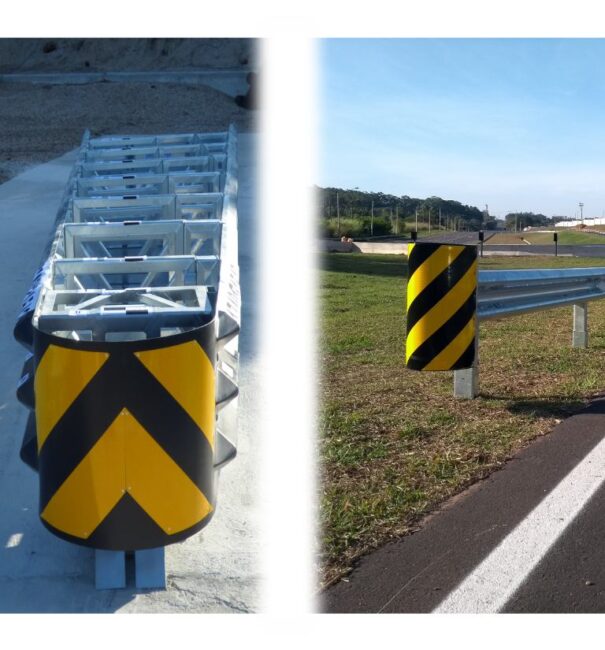
Crash cushions are installed where there is an obstacle and it is not possible to place barriers, such as in medians or at road bifurcations. Their main purpose is to absorb the energy of a collision in order to protect vehicle occupants. These systems are governed by EN 1317-3 and are classified as redirective and non-redirective. At Road Steel, we offer parallel, triangular, and asymmetric crash cushions with different performance characteristics depending on the expected speed.
End barriers, on the other hand, are designed exclusively to protect the ends of both steel and concrete barriers, preventing the end of a barrier from becoming a greater hazard than the one the barrier itself is intended to guard against. Their design aims to redirect the impacted vehicle in a controlled manner to maintain occupant safety and is regulated by the CEN TS 1317-7 specification, which classifies them according to the speed levels they are expected to withstand.
As can be seen, the purpose of these devices is different. While the crash cushion prioritizes protection against the obstacle, the end barrier is designed to reduce the risk of injury at the transition between a protected area and one without containment.
At Road Steel, we clearly understand these differences because we know that each solution addresses specific risks and contributes in a different way to safer mobility. For us, understanding these differences is not only a matter of engineering expertise, but also a commitment to road safety.